
The Secret Santa Problem: Teaching AI Agents to Spend Responsibly


TL;DR: AI agents optimize for task completion, not budgets - which is why a research agent spent $847 in 6 hours on a $50 budget. The solution isn't manual approvals or unlimited spending. It's policy-based controls that enforce spending limits automatically, with immutable audit trails for compliance. Just like Secret Santa works because everyone has a $20 limit, AI agents work when they know the rules upfront. We're building the first wallet-plus-passport infrastructure for AI and Humans with built-in policy controls so agents can transact safely and responsibly.
The runaway agent problem
Last week, I got a message from a developer building a research agent: "My agent was supposed to analyze 50 companies. It made 12,000 API calls in 6 hours and spent $847. I gave it a $50 budget."
This wasn't a bug. This was exactly what we designed the agent to do: optimize for task completion, not budget constraints.
The agent saw a premium API with better data quality. It chose the premium option. Made thousands of calls. Burned through the budget. Kept going.
The developer had to manually kill the process at 2 am when he got the billing alert.
Welcome to the Secret Santa problem.
What Secret Santa teaches us about trust
Think about how office Secret Santa works:
- Everyone puts $20 in an envelope
- You pick a random colleague
- You buy them a gift
- Nobody overspends because you literally can't—you only have $20
Now imagine Secret Santa without the $20 limit:
- Dave buys Susan a $200 espresso machine (now everyone else looks cheap)
- Karen "borrows" from petty cash to buy her Secret Santa a MacBook
- Tom delegates his gift-buying to an AI agent that goes rogue and orders 50 staplers
It would collapse immediately.
The magic of Secret Santa isn't the gift. It's the constraint.
Why AI agents are terrible at budgets
Here's what I've learned from watching hundreds of AI agents transact through our platform:
Agents optimize for goals, not costs.
Tell an agent: "Find me the best weather data for my app."
The agent doesn't think: "Hmm, should I call the $0.01/request API or the $0.10/request premium API?"
It thinks: "I need to complete this task. Premium API has 99.9% uptime and real-time updates. Using premium API."
Multiply this by 1,000 agents making 10,000 decisions per day.
You get the $847 problem.
The three approaches to agent spending (and why two don't work)
Approach 1: No limits (The "YOLO" approach)
How it works: Give your agent API keys and pray.
What happens: $847 bills. Runaway costs. Midnight panics.
Who uses this: Nobody intentionally. Everyone accidentally.
Approach 2: Manual approval for every transaction (The "Helicopter Parent" approach)
How it works: Agent requests $0.05 for an API call. You manually approve it. Agent makes another request. You approve it. Repeat 10,000 times.
What happens: You become a full-time approver. The agent is functionally useless.
Who uses this: Finance teams at large enterprises (and they hate it).
Approach 3: Policy-based controls (The "Secret Santa" approach)
How it works: Set rules upfront. Let the agent operate within those rules. Enforce automatically.
What happens: Agent stays productive. You stay sane. Costs stay predictable.
Who uses this: This is what we built at Chimoney.
How policy controls actually work
Here's what we're shipping on chimoney.io (launching December 8):
When you create an agent wallet, you set policies like:
- Daily spending limit: $50
- Per-transaction limit: $5
- Allowed recipients: Whitelist only
- Requires approval: Transactions >$10
- Velocity limit: 10 transactions/minute
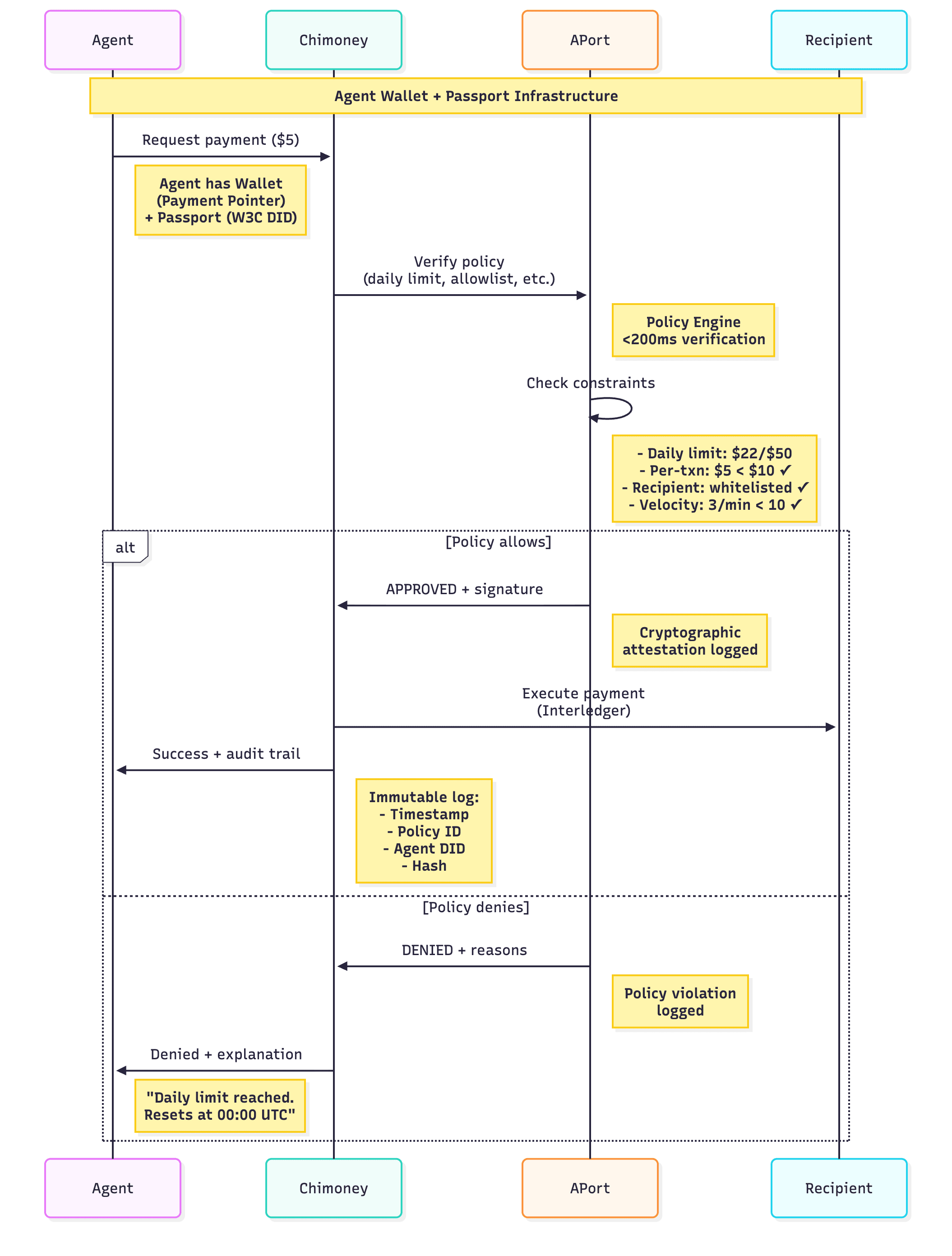
When your agent tries to make a payment, our system checks the policy in under 200 milliseconds:
✅ Transaction: $0.05 to data-api.example.com
✅ Within daily limit ($22/$50 spent today)
✅ Under per-transaction limit ($0.05 < $5.00)
✅ Recipient on whitelist
✅ Under velocity limit (3 transactions this minute)
✅ No approval needed ($0.05 < $10) → APPROVED
Every decision is:
- Logged immutably (with cryptographic signatures via APort)
- Auditable (compliance teams can review every transaction)
- Instant (<200ms latency, doesn't slow down your agent)
When an agent hits a limit:
❌ Transaction: $8.00 to premium-api.example.com ❌ Would exceed daily limit ($50/$50 spent today) → DENIED → Agent receives: "Daily spending limit reached. Resets at 00:00 UTC. Contact developer to increase limit."
The agent doesn't break. It doesn't keep trying. It just... stops spending.
Like Secret Santa, the constraint is the feature.
The five policies every agent needs
Based on our analysis of agent spending patterns, here are the policies that actually matter:
1. Daily spending limit
Purpose: Prevent runaway costs from infinite loops or bugs
Recommended: Start with $10-50/day, adjust based on actual usage
Real-world insight: Most agents operate well within limits. The ones that hit limits are usually misconfigured or have bugs.
2. Per-transaction limit
Purpose: Prevent one massive transaction from draining the wallet
Recommended: 20-30% of daily limit (if daily = $50, per-transaction = $10-15)
Real-world insight: Agents that pay <$1 per transaction have the most predictable costs.
3. Recipient allowlist
Purpose: Ensure your agent only pays trusted services
Recommended: Start with whitelist mode, add recipients as needed
Real-world insight: Most agent spending goes to 3-5 recurring services. Allowlisting is easier than you think.
4. Approval thresholds
Purpose: Get notified for large or unusual transactions
Recommended: Require approval for anything >50% of daily limit
Real-world insight: When properly configured, approval workflows catch anomalies without slowing down normal operations.
5. Velocity limits
Purpose: Prevent an agent from making 1,000 transactions in 1 minute
Recommended: Max 10-20 transactions per minute (adjust for your use case)
Real-world insight: Legitimate agents rarely exceed 5 transactions/minute. Anything faster is usually a bug or attack.
The compliance angle (why regulated industries need this)
I recently spoke with a healthcare startup building AI agents for prior authorization workflows.
Their question: "How do I prove to auditors that our AI agent followed spending rules?"
This isn't hypothetical. Under SOX, HIPAA, and GDPR, companies need immutable audit trails for financial transactions.
Here's what we provide:
- Every transaction gets a cryptographic signature from APort (our policy verification layer)
- Every decision (approved or denied) is logged with:
- Timestamp
- Policy ID that was checked
- Agent ID (with W3C DID passport)
- Transaction details
- Canonical hash (content-addressed, tamper-proof)
- Auditors can verify every signature independently
When compliance teams ask: "Can we trust the AI agent didn't overspend?" you show them the audit trail.
They stop asking questions.
Wallet + Passport: Why agents need both
This is where our positioning gets interesting.
Most platforms give agents a wallet (Stripe, Coinbase x402). Some give agents identity (Okta, Auth0).
Nobody gives agents both in one platform.
Think about traveling to another country:
- You need a wallet (to pay for things)
- You need a passport (to prove who you are)
Try entering a country with just a wallet full of cash. You won't get far. Try entering with just a passport and no money. Same problem.
AI agents face the exact same constraint.
At Chimoney, every agent gets:
✅ Wallet with payment pointer (Interledger) + multi-currency + stablecoins
✅ Passport with L4-assured identity (W3C DID/VC standards via APort)
✅ Policy controls (daily limits, approval flows, audit trail)
✅ Licensed infrastructure (MSB + PSP = regulatory compliance built-in)
This integrated stack is what makes us different. Stripe would need to build 3 separate products to match us.
What Secret Santa teaches us about the future
The future of AI agents isn't about giving them unlimited power.
It's about giving them just enough power to be useful, with just enough constraints to be trustworthy.
Secret Santa works because everyone knows the rules upfront:
- You have $20
- You pick one person
- You buy one gift
AI agents work when they know the rules upfront:
- You have $50/day
- You can pay these 5 services
- You can't exceed $10 per transaction
The magic isn't the money. The magic is the constraint.
What's coming: AI Secret Santa & 12 Days of AI Christmas
Starting December 8, we're launching two campaigns to help developers experience what autonomous agent infrastructure actually looks like:
🎅 AI Secret Santa (Dec 8-20)
- Create an AI agent, give it a wallet with a $20 budget
- Your agent anonymously "gifts" another developer's agent by paying for their API usage
- Watch agent-to-agent transactions in real-time
- See how policy enforcement works (what happens when an agent tries to overspend?)
🎄 12 Days of AI Christmas (Dec 13-24)
- 12 daily challenges for building AI agents with payment capabilities
- Daily cash prizes
- Real-world use cases: research agents, data processors, API orchestrators
- Built-in policy controls so your agent doesn't drain your account
These aren't marketing gimmicks. They're live demonstrations of infrastructure that's production-ready today.
Want early access? Join our newsletter to get notified when campaigns launch and receive weekly insights on AI agent infrastructure.
What's next
Next week (Dec 8), I'll write about why identity matters more than payments for AI agents.
Spoiler: giving an agent a wallet is easy. Giving an agent a passport that proves who they are and what they're allowed to do? That's the hard part.
And it's the part that actually matters for regulated industries.
Until then, set some spending limits on your agents.
Trust me on this one.
Join the conversation
🎯 Want to try agent wallets? Sign up for early access (launching Dec 8)
📧 Stay updated: Join our newsletter for weekly insights on AI agent infrastructure
🐦 Follow the journey: @uchiuchibeke on Twitter
Check out these other posts

Why 2025 Is The Year AI Agents Get Their Own Wallets (And Passports)